
Paws Journal · Training & Behaviour · 9–11 min read
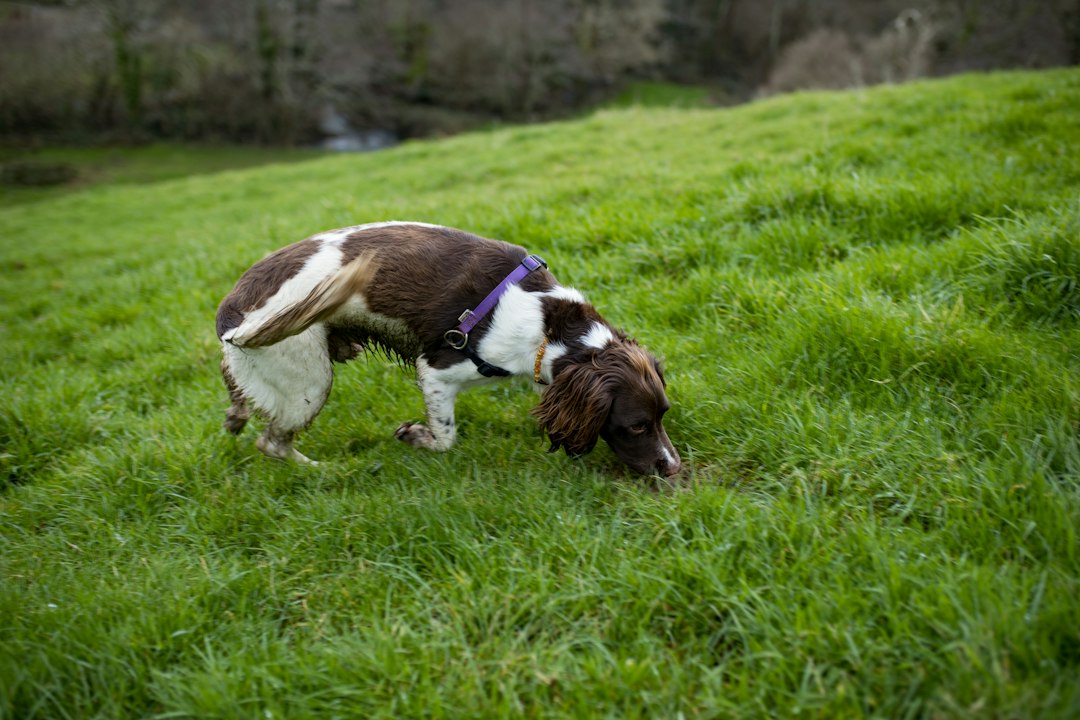
For dogs, the world is full of smells we barely notice.
While we humans tend to experience a walk mainly through what we see, our dogs are constantly collecting information through their noses. Who passed here? How long ago? Was another dog nearby? Is there food somewhere in the grass?
And according to recent research, allowing dogs to use this incredible natural ability may be far more than just entertainment.
What exactly is scent work?
Scent work is inspired by the tasks performed by professional detection dogs.
But your dog does not need to be trained to find explosives or missing people.
For a family dog, scent work can be incredibly simple: searching for hidden treats, finding a favourite toy or learning to recognise and locate a particular scent.
The basic idea is always the same.
The dog uses its nose to solve a problem.
And that small difference makes scent work interesting. Instead of constantly waiting for instructions from us, the dog gets an opportunity to explore, make decisions and succeed independently.
What does the latest research say?
Recent research published in 2026 has taken a closer look at scent-based activities for companion dogs.
One study compared dogs attending traditional positive-reinforcement training classes with dogs participating in scent work classes.
Both activities offered benefits, although in slightly different ways.
Traditional training was particularly useful for improving trainability and obedience-related skills. Owners participating in scent work classes, meanwhile, were more likely to report an improvement in their dog’s perceived quality of life.
The researchers did not conclude that scent work is “better” than traditional training.
Instead, the results suggest something perhaps more useful:
Different types of training can provide dogs with different benefits.
And giving dogs a chance to use natural behaviours such as sniffing can be a valuable addition to ordinary training.
Scientists also watched what happened while dogs searched
Another recent study looked at what actually happens to dogs during scent work.
Researchers monitored dogs while they performed a scent-searching task and compared it with simply walking around a neutral room.
During active searching, the dogs’ heart rates increased and were highest while they were focused on finding the target scent.
Interestingly, researchers also observed higher tail carriage during scent searching and did not observe stress-related behaviours during the search task.
Sniffing is not wasted time
Many owners try to stop their dogs from sniffing too much during walks.
We want to keep moving.
The dog wants to investigate the same patch of grass for thirty seconds.
But those thirty seconds may be much more interesting to your dog than another hundred metres of walking.
A good dog walk does not always need to be about distance.
Sometimes slowing down and letting your dog explore can turn an ordinary walk into a much richer experience.
Of course, there are moments when a dog needs to walk calmly beside us. Loose-lead walking, recall and basic communication remain extremely important.
But these skills do not have to replace sniffing.
A good walk can contain both.
5 easy nose-work games anyone can try
You do not need special equipment or professional training to get started.
Take a few small treats and scatter them across an area of grass. Instead of showing your dog where they landed, let the nose do the work. Start with a small area and gradually make the search more difficult.
Let your dog see a favourite toy. Ask the dog to wait while you hide it somewhere easy nearby. Then give a cue such as “Find it!” Once your dog understands the game, make the hiding places progressively harder.
Place several empty cardboard boxes on the floor and hide a treat inside one of them. Allow your dog to investigate. Do not immediately point out the correct box. Part of the fun is letting the dog solve the puzzle.
Drag a treat or favourite toy across the ground for several metres and hide it at the end of the trail. Bring your dog to the beginning and encourage them to follow the scent. As your dog improves, make the trail longer and include turns.
A forest, meadow or quiet walking trail offers thousands of natural scents. Hide a toy behind a tree, scatter treats among leaves or simply give your dog several minutes where there is no destination at all. Let them choose where to sniff.
Nose work while travelling
Scent games can be particularly useful when travelling with a dog.
A new hotel, campsite or holiday apartment can contain an overwhelming amount of unfamiliar information.
Instead of immediately expecting your dog to settle, try giving them a simple familiar search game.
Hide a few treats around the room or allow plenty of time to investigate the new surroundings.
It can create a familiar activity in a completely unfamiliar place.
And the equipment required?
Usually nothing more than a handful of treats and your dog’s nose.
Does scent work replace training?
No.
Recall, calm behaviour around other dogs, loose-lead walking and basic communication are still essential skills, especially when travelling or exploring public spaces together.
Think of scent work as another tool.
Traditional training often asks: “Can you listen to me?”
Scent work sometimes asks something different: “Can you solve this yourself?”
A balanced dog life probably needs a little of both.
The next time your dog stops to sniff…
You do not always have to hurry them along.
Watch what happens.
Their nose moves rapidly. Their direction changes. They follow an invisible trail that makes absolutely no sense to us.
To your dog, however, there may be an entire story hidden in that patch of grass.
Sometimes one of the best things we can give our dogs is not another command.
It is simply the time and freedom to be a dog.
Paws & Stays Tip
On your next walk, dedicate just 10 minutes exclusively to your dog’s nose.
No rushing. No predetermined distance. Let your dog choose where to investigate.
You might walk less. But for your dog, the walk could become much more interesting.
This article was independently written in our own words. No source text has been reproduced.
- Sobol & Dowling-Guyer — Effects of scentwork and traditional training classes on dog welfare, behavior, and human–dog bond (2026)
- Fountain et al. — Heart rate variability and behaviour in dogs during and after scent work (2026)
Photo credit: Celyn Bowen / Unsplash. Used under the Unsplash licence and cropped for layout.