
Paws Journal · Worth Knowing · 6–8 min read
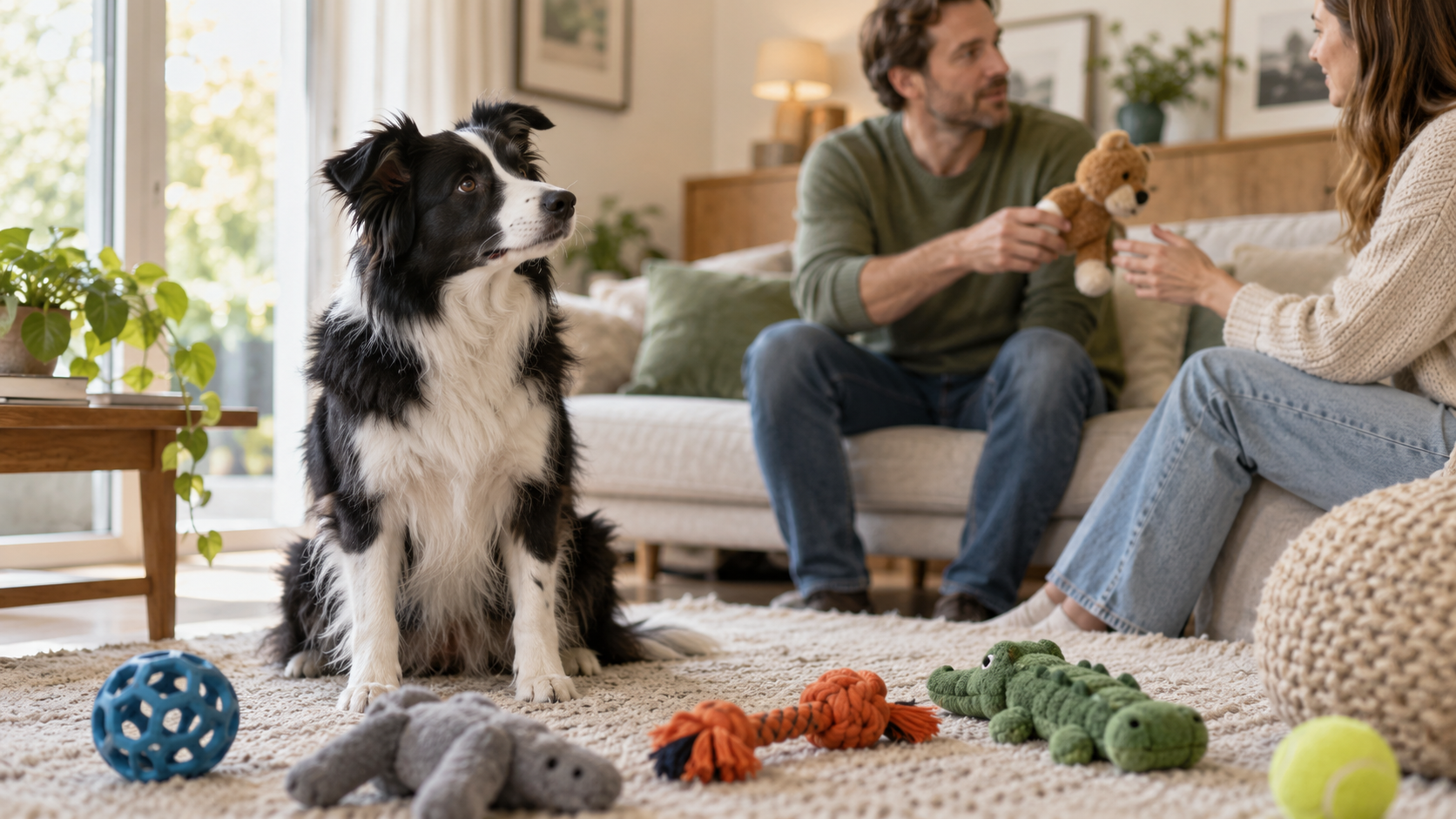
Most dog owners know that dogs listen even when nobody is speaking directly to them. But are they only reacting to familiar sounds and routines, or can they actually learn completely new words by quietly listening to a conversation?
A rare talent: dogs that know hundreds of toy names
Researchers call them Gifted Word Learner dogs. They are extremely rare and already possess an unusually large vocabulary of object names.
This is different from responding to commands such as “sit” or “stay”. These dogs appear to understand that a particular word refers to a particular object. When asked to bring a named toy from another room, they can distinguish it from many others.
Earlier studies found that most family dogs do not reliably learn object names in this way. The ability therefore appears to be an exceptional talent rather than a normal skill shared by every dog.
How the experiment worked
The main experiment involved ten Gifted Word Learner dogs. Each dog was introduced to two completely new toys, and the researchers compared two learning situations.
The owner spoke directly to the dog while presenting, naming and playing with the new toy.
The owner spoke to another family member and passed the toy back and forth. Neither person addressed or looked at the dog.
The dog simply watched and listened from the side. Each toy label was presented for a total of eight minutes, spread across four separate days.
Afterwards, the two new toys were placed in another room among nine familiar toys. The owner then asked the dog to retrieve one of the new toys by name.
Listening worked almost as well as direct teaching
The dogs performed remarkably well in both situations. Their median success rate was approximately 92% when they were directly addressed and around 83% when they had only overheard the conversation.
Seven of the ten dogs performed significantly above chance in both conditions. The researchers did not find a statistically significant difference between direct teaching and overhearing.
In practical terms, these gifted dogs learned almost as effectively while observing a conversation as they did when their owners actively taught them.
They could connect a word with a hidden object
The researchers then made the task more difficult. A new toy was first shown to the dog and then placed inside a special container where it could no longer be seen. Only after hiding the toy did the owner begin using its name.
The dog therefore had to remember which object had disappeared and connect that mental image with the word heard afterwards.
Eight gifted dogs completed this part of the study. Their median success rate was approximately 79%, and five performed significantly above chance individually. When tested again two weeks later, the dogs still remembered the associations.
Does this mean dogs understand language like children?
Not quite. The researchers describe the dogs’ abilities as functionally similar to certain learning processes observed in children around 18 months of age. This does not mean that dogs possess human language or understand an entire conversation in the same way people do.
Children eventually learn grammar, abstract meanings and an enormous vocabulary. The dogs in this study learned labels for concrete objects, mainly toys.
The important discovery is that some of the social-cognitive skills needed to learn from other people’s conversations may not be exclusively human.
Why this does not apply to every dog
The study also included ten typical family Border Collies without an established vocabulary of toy names. Some initially appeared to choose correctly, but closer analysis showed that they usually preferred one of the two unfamiliar toys.
Once this natural attraction to new objects was considered, none showed convincing evidence of learning the labels by overhearing.
The result is therefore not that every dog can learn new vocabulary by listening. It shows that a very small and unusual group of dogs can. Scientists still do not know exactly why. Many identified Gifted Word Learners are Border Collies, but breed alone cannot explain the ability because most Border Collies do not demonstrate it.
What owners can try at home
- Give individual toys short and clearly different names.
- Use each name naturally during play.
- Introduce only one or two new objects at a time.
- Keep the activity relaxed and enjoyable.
- Ask the dog to retrieve a toy from a group without pointing or looking towards it.
- Avoid repeating the request until the dog eventually guesses correctly.
A dog that does not learn object names is not less intelligent. Dogs can excel in scent work, spatial problem-solving, social communication, movement or practical tasks without developing a large toy vocabulary.
Our view
The most interesting part of this research is not that a few dogs can memorise impressive lists of toys. It is that they appear to learn by observing the social world around them. For owners, the study is a useful reminder: dogs may pay far more attention to our conversations, gestures and everyday routines than we realise.
Important: This article does not provide individual training or behavioural advice. It presents our interpretation and plain-language explanation of published research for general information only.
Primary research: Dror, S., Miklósi, Á., Morvai, B., N?stase, A.-S. and Fugazza, C. (2026). “Dogs with a large vocabulary of object labels learn new labels by overhearing like 1.5-year-old infants.” Science, 391(6781), 160–163. DOI: 10.1126/science.adq5474.
Additional context: University of Veterinary Medicine Vienna research summary.
Hero image: original AI-generated editorial image created for Paws & Stays. No third-party photograph was reproduced.