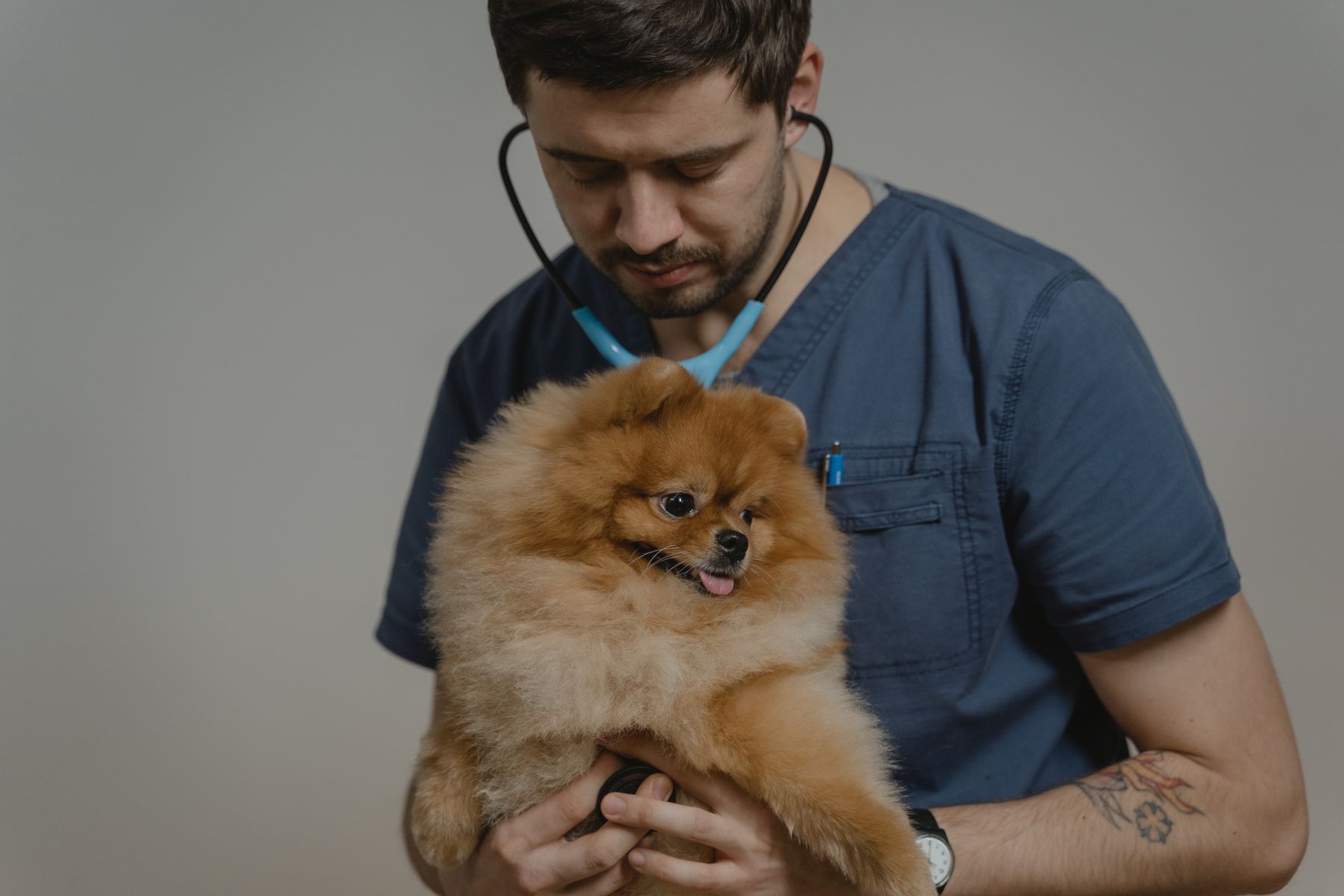
What listening to your dog’s heart can reveal — and what it can miss
The vet places the stethoscope on your dog’s chest, listens for a moment and says: “There’s a heart murmur.” A short sentence that can raise a lot of questions. How serious is it? What needs checking? A large new study helps put the finding into perspective.
Listening is a starting point
For the LISTEN study, 50 vets with cardiology training examined 6,996 dogs. At the same appointment, each dog’s heart was assessed using a standardised listening protocol and an ultrasound scan. Published on 13 October 2026, the study compared recorded murmurs with the ultrasound findings. [1]
Louder does not always mean more serious
In dogs with myxomatous mitral valve disease, louder murmurs were associated with more advanced disease at group level. But there was considerable overlap between individual dogs. The pattern was different in dilated cardiomyopathy, a disease of the heart muscle: 25.8 per cent of affected dogs had no audible murmur. Murmur loudness did not increase consistently with disease stage in this condition either. [1]
The study shows why listening and ultrasound provide complementary information. Loudness alone cannot establish the precise diagnosis or stage of disease. [1]
What the study cannot tell us
Most dogs were undergoing specialist cardiac assessment. The results therefore do not describe how common these diseases are among all pet dogs. Multiple examiners, a lack of blinding and murmur assessments that were not checked centrally may have influenced the findings. The study did not calculate how accurately a general screening examination detects disease. [1]
Bring your questions to the appointment
As owners, we do not need a crash course in cardiology. What helps is a conversation that makes the finding understandable: What was heard? What do we already know? Which further examination would answer which question? And what is the next step for this particular dog?
Write your questions down beforehand if that helps. It is easy to forget them when you are worried. Specific observations from everyday life can also help the conversation. A number or a term in a report should not become a diagnosis you make on your own.
Our vets and veterinary care section offers places to start. For another perspective on individual treatment and research, read When a dog develops cancer.
Our thoughts at Paws & Stays
An unexpected finding can leave you feeling unsteady for a moment. We believe clear explanations are part of good care, just as much as the examination itself. Your dog is still your familiar companion, with favourite walks, daily habits and little quirks. They have nothing to prove. We can be there for them, ask questions and work with the veterinary team to find a suitable way forward.
Sources and context
- Wess G. et al. (13.10.2026). Prospective multicenter study of murmur localization and stage-associated murmur grading in dogs with echocardiographically diagnosed cardiac diseases: the LISTEN study. Frontiers in Veterinary Science 13:1944439. Original study and full text · DOI: 10.3389/fvets.2026.1944439.
We read the original paper, including its methods and limitations. This is an observational study. Our suggestions for conversations with the vet are editorial guidance; the study did not test them as interventions. Updated: 16 October 2026.